
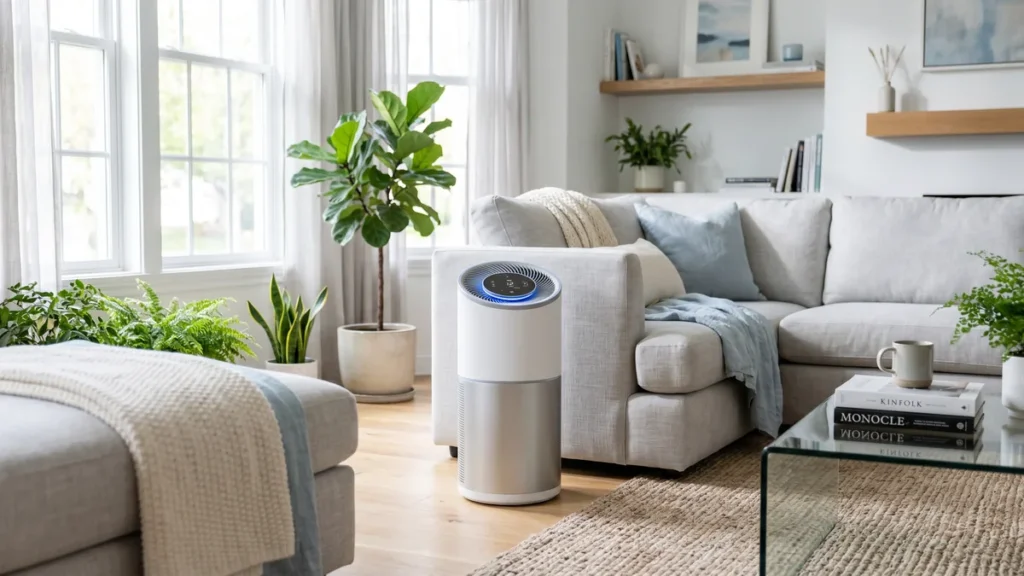
An air purifier is one of the simplest ways to improve the air in your home, but the box is covered in numbers and claims that make models hard to compare. Strip it back and three things decide whether a purifier actually works for you: the filter it uses, how fast it cleans, and whether it is sized for your room. Get those three right and the rest is detail.
This guide walks through each one in plain terms, including a chart that matches clean air delivery to room size, so you can buy a unit that does the job without paying for capacity you do not need.
Start with the filter: what HEPA really means
A True HEPA filter captures 99.97 percent of airborne particles as small as 0.3 microns, which covers pollen, fine dust, mold spores, pet dander, and smoke particles. That 0.3 micron size is the hardest of all to trap, so a filter that hits the mark there performs even better on particles that are larger or smaller.
Watch the wording on the box. “True HEPA” or a grade of “H13” is the real standard. Terms like “HEPA-type,” “HEPA-like,” or a bare “99 percent” with no 0.3 micron figure signal a weaker filter that lets more through. A strong purifier also works in layers: a pre-filter grabs hair and large dust, the HEPA layer catches the fine particles, and an activated carbon layer absorbs odors, smoke gases, and VOCs. HEPA on its own does not remove smells or gases, so if odor is your concern, confirm there is real carbon inside.
CADR: how fast it actually cleans
CADR, or Clean Air Delivery Rate, is the one spec that lets you compare purifiers honestly. It is measured in cubic feet per minute and verified by AHAM, an independent testing body, so look for the round AHAM Verified seal rather than a marketing number the maker printed itself.
You will usually see three CADR figures: one for smoke, one for dust, and one for pollen. Smoke is made of the smallest particles and is the hardest to remove, so it is the number to size around. Higher is faster. A purifier rated 200 CADR clears the same room about twice as quickly as one rated 100.
Match CADR to your room size
Sizing a purifier is a lot like sizing an air conditioner: the capacity has to fit the space. AHAM’s rule of thumb is that the smoke CADR should be at least two-thirds of the room’s area in square feet, assuming standard 8 ft ceilings. That works out to cleaning all the air in the room roughly four to five times an hour, the rate that allergy and asthma guidance calls for.
| Room size (sq ft) | Minimum smoke CADR | Typical space |
|---|---|---|
| 100 | 65 | Small bedroom, office |
| 150 | 100 | Bedroom, nursery |
| 250 | 165 | Large bedroom, den |
| 300 | 200 | Living room, home office |
| 400 | 265 | Open living area |
| 500 | 335 | Large or open-plan room |
Watch out for inflated coverage claims. Many boxes advertise “covers up to X sq ft” based on cleaning the air just once or twice an hour, which is too slow to keep allergens down. For real relief, treat that headline number as roughly half. A unit sold as good for 800 sq ft behaves more like a 400 sq ft purifier at the speed that actually clears the air.
What the numbers do not tell you
Two purifiers with the same CADR and HEPA rating can still be very different to live with. Check these before you buy:
- Noise. A purifier is quiet on low and loud on high. Size up one step so you can hit the CADR you need on a medium setting instead of running it wide open. Look for the decibel rating on the low and high speeds.
- Filter cost. Factor in replacements. True HEPA filters typically last 6 to 12 months and carbon 3 to 6, so a cheap unit with expensive filters can cost more over a couple of years than a pricier one.
- Skip ozone. Avoid “ozone generators” and any device that cleans by producing ozone, which the EPA warns can irritate the lungs. In California, choose a CARB-certified model, a program that screens air cleaners for safe ozone output.
- Energy use. An ENERGY STAR certified purifier uses about 40 percent less energy than a standard model, which adds up because you run it around the clock.
- It is not a dehumidifier. A purifier removes particles, not moisture. If damp air, musty smells, or mold are the real issue, pair it with a dehumidifier instead.